Module #2 Blog
Hey there! Welcome back! Coming off of the pandemic and finally packing up my virtual classroom (hopefully for good!), I have found myself increasingly using technology in my classroom. Although I feel like the increase of technology usage in my classroom has been helpful, both to me and my students, I can't help but doubt my gut feeling sometimes.
 |
| Source: giphy.com |
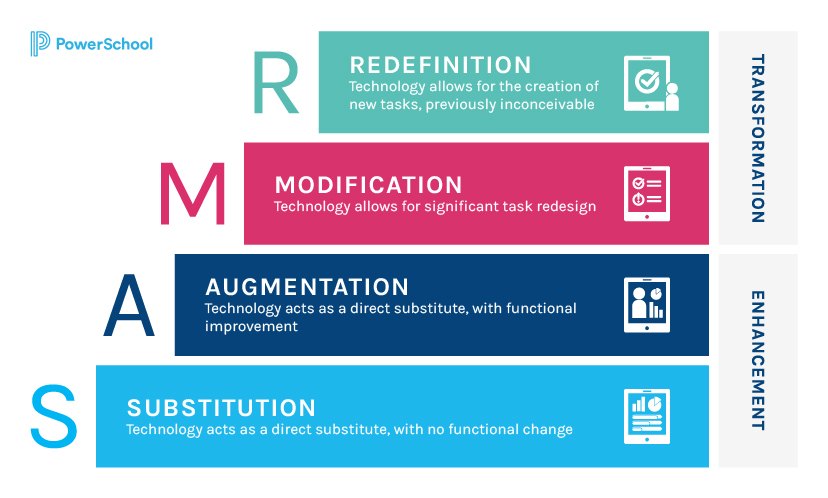
It was not until very recently that I discovered that frameworks for technology integration in the classroom actually exist! SAMR is one framework that I have spent some time looking into and implementing in my own instruction, in order to determine whether or not I am effectively using technology in my classroom. SAMR is an acronym that stands for "Substitution, Augmentation, Modification, and Redefinition". This acronym represents the levels to which educators are at in regards to technology implementation within the classroom.
 |
| Source: PowerSchool |
Level 1:
Substitution.
"Substitution"is the stage of this framework in which technology acts as a direct substitute, with no functional change.
This stage of SAMR is the very surface level of technology integration within the classroom. In 2023, we are basically all at this level at the minimum.
Level 2:
Augmentation.
"Augmentation" is the stage of this framework in which technology acts as a direct substitute, with functional improvements.
This is where educators take their digital lessons and enhance them to be more interactive for the students by incorporating things like images, videos, and hyperlinks that lead to other resources.
Level 3:
Modification.
"Modification" is the stage of this framework in which technology allows for significant task redesign.
This stage of the framework is where educators implement technological avenues for other aspects of education such as grading, communicating with students, and posting assignments. These avenues, such as Google Classroom and Schoology, have really taken off in popularity since the start of the pandemic.
Level 4:
Redefinition.
"Redefinition" is the stage of this framework in which technology allows for the creation of new tasks, which were previously inconcievable.
According to Youki Terada's article from Edutopia, this is the stage in which learning is "fundamentally transformed, enabling activities that were previously impossible in the classroom". During this stage, educators find creative avenues to teach their content that would otherwise be impossible to implement without the use and availability of technology.
Where do I rank?
After reflecting on my teaching and where I find myself falling in the SAMR framework, I ultimately decided that I regularly visit every level of SAMR, however, I typically spend the most amount of time in SAM. Following the pandemic, substituting materials became standard for the educators at my school. We became a 1:1 chromebook school and have become less and less dependent on paper and pen. As the years have passed, we have been trained on using various resources to augment our online materials. Our department made the shift from standard Google Slides to implementing Peardeck instead to increase student engagement. Lastly, the pandemic introduced our school to Schoology, which has become the core of all of our classrooms at my current school. Everything runs through Schoology, including our gradebook. Students and teachers alike have become so dependent on Schoology's functionality to be successful in class.

Hi Justin! I enjoyed reading your blog, it was very helpful as I also became familiar with the SAMR technology model. I am a 3rd grade teacher and this is typically the first year (at my school anyways) that students really begin to use technology every day. I have had many positive experiences with using technology with this young of students. It allows them to develop skills and using higher-leveled thinking skills as they have more resources available to them. I have also found through research that the majority of time, I use SAM of the model. I would love to implement technology more by lining it up with the redefinition stage. Thanks for sharing your experience!
ReplyDelete-Mayci Edwards
Hi Justin, It's great to hear about your reflection on your teaching practice and your engagement with the SAMR framework. At my school, we are a 1:1 with Chromebook books as well. I find that my students are easily distracted by online games. It's evident that you've undergone a significant transformation, particularly in your technology integration, which aligns with the SAMR model's levels.
ReplyDelete